If you’ve ever stood on a production floor and watched a paper sheeting machine zip through a ream of raw jumbo roll like it’s just plain paper, you’ve probably found yourself asking the same question I get all the time: How fast can these things actually go? For the last 12 years, I’ve been the guy answering that question for paper mills, packaging converters, and even small-scale specialty paper producers that reach out to our team (I’m not here to drop a sales pitch before we even get to the numbers, though). The truth is, there’s no one-size-fits-all answer to this—speed isn’t just a number on a spec sheet; it’s a balance between raw machine design, paper quality, downtime, and what you actually need to get done on your floor. Let me break this down like I do for every new client who walks through our demo lab. Paper Sheeting Machine
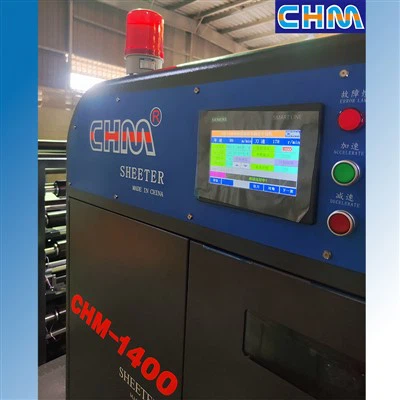
First, let’s start with the baseline, because that’s where almost every conversation starts. For a standard corrugated linerboard or newsprint jumbo roll—your garden-variety paper that’s strong enough to hold up to being pulled through machinery—our mid-tier sheeters (the ones that most small to mid-sized converters and packaging mills use) run at a steady 120 to 180 meters per minute. That translates to roughly 390 to 590 feet per minute, if that’s the unit you’re used to. That number isn’t pulled out of thin air, either. The Paper Industry Technical Association (PITA) has tracked production speeds for over 20 years, and that 120–180 m/min range is what’s considered “reliable high-speed operation” for standard grade paper. Run slower than that, and you’re leaving money on the table—labor and overhead don’t slow down just because your machine does. Push faster, though, and you start running into real problems.
Here’s where the first big constraint hits: paper properties. Not all paper is the same, and that’s the biggest limiting factor for speed. If you’re working with lightweight tissue paper, for example, it’s delicate—too much tension at high speed will cause it to stretch, tear, or even develop wrinkles that make it unusable. For tissue, our high-speed sheeters max out around 150 m/min, and even that requires specialized tension control systems we’ve spent years refining. On the opposite end, if you’re working with thick, heavy cardboard or coated label stock, you might be able to push that speed higher—but not by much. Coated paper, in particular, has a tendency to slip on the rollers at high speeds, which leads to misaligned sheets and waste. We had a client last year who tried to run 300 gsm coated label stock at 200 m/min, and they threw out 12% of their first batch because of slippage. They dialed it back to 160 m/min, and waste dropped to less than 1%—a difference that saved them $45,000 over a quarter. That’s the kind of real-world tradeoff we live with in this industry.
Then there’s the big players, the full-production mills that run nothing but bulk packaging material. For those, our heavy-duty, industrial-grade sheeting machines—built with reinforced frames, high-precision cutting blades, and automated splicing systems—can hit speeds of up to 300 meters per minute, which is almost 1,000 feet per minute. I’ve seen these machines run in person, and it’s wild: a jumbo roll that weighs 3 tons gets unloaded, spliced to a new roll in under 10 seconds, and cut into 1000+ sheets per minute, all without stopping. But even at that speed, downtime kills you. The difference between a machine that runs 20 minutes without a jam vs. 2 minutes is huge. We test all our machines on this: at our demo facility, we’ll run a heavy linerboard roll at 280 m/min, and over an 8-hour shift, you’ll get maybe one small adjustment for a mis-cut sheet. Push it to 320 m/min, and you’re stopping three or four times an hour to clear jams, replace dull blades, or adjust tension. That adds up to 2 hours of downtime a shift, which eats into every profit margin. I always tell clients: “The fastest speed isn’t the best speed. The speed that lets you run 95% of the time without waste is the one you should care about.”
Now, let’s talk about the factors that actually let you push those speeds. The biggest one, hands down, is automation. Ten years ago, a sheeting machine operator would have to adjust tension, realign rolls, and change cutting settings manually—all while the machine was running. That meant slower speeds, because you couldn’t make those adjustments fast enough. Now, with automated tension control, digital roll alignment, and blade sharpening systems, operators can adjust settings in 2 seconds, not 2 minutes. We added a new predictive maintenance module to our machines three years ago, and clients that use it report a 15% increase in usable speed, because they don’t have to stop for unplanned repairs. For example, a major packaging converter in Ohio switched to our automated sheeters last year, and they were able to increase their production from 12,000 sheets an hour to 18,000, with the same number of operators. That’s not just speed—that’s efficiency.
Another often-overlooked factor is sheet size. It might sound simple, but cutting a jumbo roll into small, 8.5×11 inch office paper sheets is way different than cutting it into 5×5 foot corrugated boards. Smaller sheets mean more cuts per roll, so the machine has to adjust the cutting mechanism more often, which slows things down. For office paper, our sheeters run at a top speed of around 180 m/min, because they’re making 400+ cuts per roll. For larger sheets, like the ones used for cardboard boxes, we can get up to 250 m/min, because there are fewer cuts. If a client comes to us wanting to run small sheets faster, we can adjust the blade design to cut more precise edges without pausing, but even then, there’s a limit. I had a client in the printing industry try to run 4×6 inch business cards at 200 m/min, and the edges came out too rough—they had to add an extra trimming step, which erased all the time they gained from higher speed. Again, it’s not just about the number on the screen; it’s about the whole process.
I also get asked all the time: “What about the future? Can’t you build these machines faster?” The short answer is yes, but there’s a ceiling. Right now, the theoretical maximum speed for a sheeting machine, based on mechanical design and material science, is around 350 m/min. But that’s for paper that’s perfectly manufactured, with no variations in thickness or texture—something that almost never happens in real production. Even the most consistent jumbo rolls have tiny variations in moisture content, which changes how the paper responds to tension. At speeds above 300 m/min, those tiny variations become big problems. The paper stretches, cuts unevenly, or tears, and by the time you catch it, you’ve wasted hundreds of sheets. I’ve seen our R&D team test a prototype machine at 320 m/min with a perfectly uniform paper roll, and it works flawlessly for an hour. But when they switched to a standard production roll, they were replacing broken blades every 10 minutes and throwing out 10% of the output. So for now, that theoretical speed is just that—something to test in a lab, not something you can rely on for a real production floor.
If you’re sitting here thinking, “Okay, so what does this mean for my business?” let’s put it in perspective. Let’s say you run a mid-sized packaging shop that produces 100,000 sheets of corrugated board a week. With a standard sheeter running at 150 m/min, that’ll take you about 12 hours of run time. If you upgrade to a high-speed machine that runs at 220 m/min, you can cut that run time down to 8 hours—freeing up your operators to do other work, or even run an extra shift without adding labor costs. But if you go for the top-of-the-line heavy-duty model running at 280 m/min, you might only need 6 hours—but only if your paper is consistent and you have the automated systems to keep it running without downtime. The sweet spot for most businesses, from what we’ve seen, is around 160–200 m/min. It’s fast enough to boost production by 20–30% without a lot of extra costs or headaches.
At the end of the day, when a client asks me how fast their sheeting machine can run, I don’t throw out a number. I ask them about their paper, their production goals, their downtime history, and how much waste they can afford. Because speed is only useful if it works for your specific operation. I’ve had clients who run specialty art paper that needs to be handled gently, so a speed of 100 m/min is perfect for them, even though our machine can go faster. I’ve also had clients that run bulk grocery bags, where every extra sheet an hour adds up to thousands of dollars a month, so they push their machines to 250 m/min, as long as they stay on top of maintenance.

If you’re looking to upgrade your sheeting machine or just want to figure out what speed makes sense for your operation, our team is here to walk you through it. We don’t believe in one-size-fits-all solutions, and we won’t sell you a machine that’s way too fast for your needs, or not fast enough to help you hit your goals. We have demo labs where you can test your actual paper on our machines, and our technicians can help you work through every variable—from paper tension to blade sharpness—to find the sweet spot that works for you. Whether you’re a small startup just getting off the ground or a large mill looking to scale, we can help you balance speed, quality, and cost. Don’t just chase the highest number on a spec sheet; focus on what makes your operation run better. That’s the real answer to how fast a paper sheeting machine can operate.
5 Ply Flute Laminator References
- Paper Industry Technical Association (PITA). (2022). Sheeting Machine Performance Standards: Speed, Quality, and Downtime Metrics. PITA Technical Bulletin 22-04.
- American Forest & Paper Association (AF&PA). (2021). Specialty Paper Processing: Tension Control and Speed Limitations. AF&PA Operations Report.
- International Fiber Science and Technology (IFST). (2023). Mechanical Constraints in High-Speed Paper Sheeting: Material Variability and Machine Design. IFST Journal of Industrial Paper Processing, Vol. 45, No. 2.
- Global Paper Machinery Manufacturers Association (GPMMA). (2020). Benchmarking Data for Industrial Sheeting Equipment: Speed Ranges by Paper Grade. GPMMA Industry Benchmark Report.
Sheng Ding Group Limited
We’re well-known as one of the leading paper sheeting machine manufacturers and suppliers in China. With abundant experience, we warmly welcome you to buy advanced paper sheeting machine for sale here from our factory. For quotation, contact us now.
Address: FLAT E 16/F SUPERLUCK IND CTR 57 SHA TSUI RD PHASE 2 TSUEN WAN NT
E-mail: chm007@szchm.com
WebSite: https://www.packagmachine.com/
