Hey there! I’m someone who runs a supplier business for Integrated Safety Edges. Today, I wanna chat about the water – resistance properties of these nifty safety edges. Integrated Safety Edge
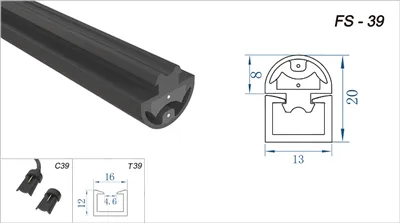
So, first off, let’s talk about why water resistance matters in an Integrated Safety Edge. In a lot of industrial and commercial settings, these safety edges get exposed to all sorts of elements. There could be spills, leaks, or even a bit of splashing from nearby cleaning processes. If the safety edge isn’t water – resistant, it could start to malfunction pretty quickly. That’s a big no – no because these safety edges are crucial for protecting people and equipment.
One of the key things behind the water – resistance of our Integrated Safety Edges is the materials we use. We’ve spent a long time researching and testing different materials to find the best ones for the job. The outer layer of our safety edges is made from a special type of rubber. This rubber is super tough and has natural water – repellent properties. It’s like a shield that keeps the water out and prevents it from seeping into the internal components of the safety edge.
The way this rubber is formulated is a bit of a trade – secret, but I can tell you that it goes through a series of chemical treatments. These treatments make the rubber more resistant to water and also enhance its durability. We don’t want the rubber to wear out quickly when it’s exposed to water, right? So, these treatments ensure that the rubber keeps its water – resistance and integrity over a long period.
Now, let’s get into the seal design. The edges of our Integrated Safety Edges are sealed really well. We use a high – quality sealing compound that creates an airtight and watertight barrier. This compound is applied during the manufacturing process, and it fills in all the tiny gaps and spaces between the different parts of the safety edge. This is important because even the smallest gap could let water in.
Imagine if a drop of water managed to get inside the safety edge. It could cause corrosion of the internal wires or damage the electronic components. But with our tight seal design, that’s not gonna happen. The water just runs off the edge, and the safety edge keeps on doing its job.
We’ve also conducted some pretty rigorous water – resistance tests. In our lab, we’ve simulated all kinds of wet conditions. We’ve splashed water on the safety edges, soaked them in shallow pools, and even exposed them to high – pressure water jets. And guess what? Our safety edges have passed all these tests with flying colors.
In a real – world scenario, if there’s a minor flood in a warehouse or if there’s a lot of steam in a factory environment, our safety edges will still work as they should. They’re built to handle these tough situations and keep providing that all – important safety function.
Another aspect of the water – resistance properties is the protection of the electronic sensors inside the safety edge. These sensors are what detect when something comes into contact with the edge. Water can play havoc with these sensors. But we’ve taken extra precautions to protect them.
We’ve encased the sensors in a special waterproof housing. This housing is made from a hard – plastic material that’s resistant to moisture. It shields the sensors from any water that might manage to get past the outer rubber layer and the seal. So, even if there’s a little bit of water around, the sensors will keep functioning accurately.
Now, you might be thinking, "Okay, this all sounds great, but how does the water – resistance affect the performance of the safety edge in other ways?" Well, the good news is that the water – resistance doesn’t compromise any other aspects of the safety edge’s performance.
The flexibility of the safety edge, which is really important for it to work effectively, remains intact. The sensitivity of the sensors also stays the same. Whether it’s dry or wet, the safety edge will respond quickly when it’s touched. This means that the safety of your workers and equipment is never at risk, no matter the environmental conditions.
If you’re in the market for an Integrated Safety Edge, water – resistance should definitely be on your checklist. You don’t want to end up with a product that stops working after a little bit of water exposure. Our water – resistant Integrated Safety Edges are designed to last. They can handle the daily wear and tear, as well as the unexpected water – related incidents in your workplace.

So, if you’re interested in learning more about our Integrated Safety Edges and their water – resistance properties, why not reach out to us? We’d be more than happy to have a chat with you about your specific needs. Whether you’re in a small workshop or a large industrial facility, we have the right safety edge solution for you. Let’s get in touch and start a conversation about how we can help keep your place safe with our top – notch safety edges.
Rubber Safety Edge References
- Manufacturer’s research notes on rubber materials and their properties
- Test reports from our in – house water – resistance testing procedures
- Industry literature on safety edge design and functionality
Ningbo Futai Safety Edge Technology Co., Ltd.
Ningbo Futai Safety Edge Technology Co., Ltd. is one of the most professional integrated safety edge manufacturers and suppliers in China, also supports customized service. Please feel free to buy advanced integrated safety edge in stock here from our factory. Contact us for free sample and discount information.
Address: No. 1116, Beihuan West Road, Jiangbei District, Ningbo City, Zhejiang Province
E-mail: info@safety-edge.com
WebSite: https://www.safety-edge.com/
